



America’s data center footprint is expanding, but the number of facilities in each state doesn’t necessarily tell the whole story. There’s also the question of what data center growth means for a community in terms of infrastructure, resources, property, and whether the community is ready for such a development.
As more parts of the U.S. are being asked to accommodate data centers, this study, from Marietta personal injury lawyer Jones & Swanson, looks into some key surrounding issues, including infrastructure cost coverage, water demand management, electricity price concerns, and how data centers affect property values.
We also consider how communities should prepare for a nearby data center, plus the potential threat to nearby residents’ (and workers’) health that a data center may represent.
First, let’s focus on the states that feature the biggest digital footprint.
America’s Digital Footprint: Key States
Currently, Virginia has the largest listed data center footprint in the country (674 facilities), followed by Texas (537) and California (296). Georgia ranks fourth with 276. (Note: The ranking counts operational, currently being constructed, planned, and land-banked listings.)
America’s Top 10 States by Listed Data Center Numbers
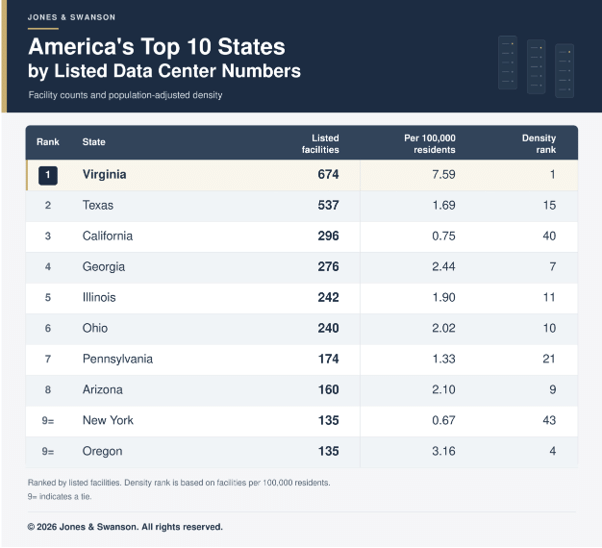
With 137 more listed facilities than Texas (a 25.5% gap), Virginia can safely be considered the U.S. hot spot for data centers: at least, it can from a purely numerical standpoint.
Virginia also ranks first in a population-adjusted density position (7.59 listed facilities per 100,000 people). That said, those ranking just behind Virginia for listed center density create a very different ranking table from the one seen above: Wyoming (5.27 listed centers per 100,000), Iowa (3.58), Oregon (3.16), and North Dakota (2.88) make up the rest of the per-capita top 5.
The distinction is crucial because a count of the number of facilities doesn’t measure electricity demand, how much water is used, or a state’s capacity for centers. Plus, a state can feature many listed facilities without those facilities being of a uniform size or even fully developed.
California perfectly illustrates the contrast. It ranks third by facility count but only 40th by density, with 0.75 facilities per 100,000 people.
Planned Development is Changing The Data Center Map
When we look at planned facilities, their geographical spread tells us that the data center map is rapidly changing.
A February 2026 Pew Research study confirms that 67% of planned facilities are mooted for rural areas, with just 13% of operating facilities in rural spots. It also found that 39% of planned facilities will be built in counties that currently feature no existing data center.
That means the next stage of the national data center roll-out could affect communities with little or no previous experience of data center infrastructure or other associated issues.
Georgia, which ranks fourth in the U.S. by current listings and seventh by density, features 94 operating facilities. Data also suggests that a further 141 facilities are planned, meaning 60% of the state’s data centers are yet to be built.
(These statistics shouldn’t be interpreted as though the difference between existing and planned facilities represents new construction.)
Overall, the national picture has several complex layers. The number of facilities is significant, yet those facilities vary in size and output, and per capita data adds key population context.
And when we consider capacity, electricity demand, and water requirements, it’s clear that each factor demands its own close focus and key questions. Such as: does a data center mean more expensive electricity?
Who Pays to Power the Data Centers?
Data centers need plenty of electricity, yet rising residential electricity prices are due to a variety of factors. Statewide electricity prices also reflect fuel costs, utility structures, customer mix, how much electricity a state consumes, and regulatory oversight.
June 2026 data suggests that residential electricity prices increased in successive years in nine of the ten states that featured the largest listed data center footprints (Arizona was the exception). Here’s a comparison of June 2025 and June 2026 figures.
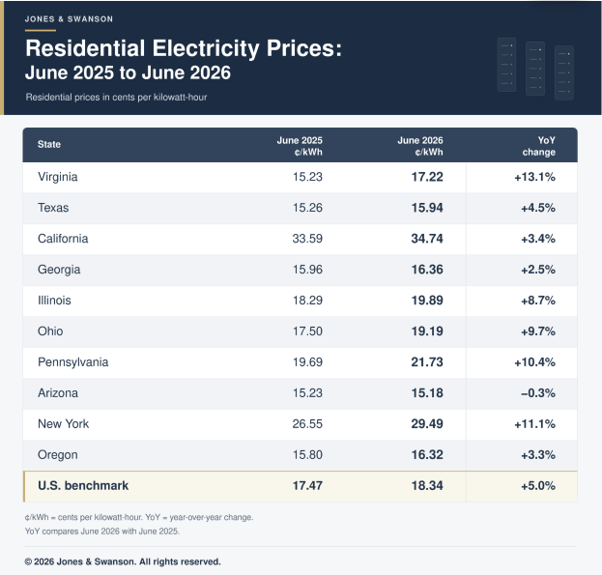
Five states (Virginia, New York, Pennsylvania, Ohio, and Illinois) saw increases over the 5% national increase. Virginia’s 13.1% rise was the most significant in this selected group; Georgia’s 2.5% increase was below the U.S. benchmark.
Long-term, a key issue is how much electricity data centers may eventually need. A June 2026 Lawrence Berkeley National Laboratory study suggested that data centers may account for 9.5% to 15.3% of national electricity consumption by 2030, with a reference estimate of 11.8% (649 TWh).
Virginia provides a good example of assessed projected infrastructure costs. A December 2024 Virginia JLARC review estimated that data center growth could soon mean a $14-$37 rise to a typical Dominion residential customer’s generation and transmission costs.
The distinction is important, as projected infrastructure costs are separate from projections regarding established data center charges.
Georgia’s Cost Allocation
In July 2025, Georgia Power was approved for a base-rate charge freeze for at least three years (although this doesn’t freeze every part of a customer’s bill).
Georgia Public Service Commission Docket 57171 includes a hearing regarding real-time-pricing revenue credits and allocation methodology. That means cost allocation is an active regulatory issue as opposed to proof that residents subsidize data centers.
For each project, the relevant questions are specific and refer to:
- The necessary generation and transmission infrastructure
- Who’s covering the cost
- The tariff
- Assumptions regarding demand
- How costs are allocated.
Statewide electricity prices and price fluctuations can’t measure any of the issues in question.
Data Center Water Demand
Water is another key factor, with data centers directly affecting water demand (through cooling systems) and indirectly (through the power needed to supply them).
An August 2026 Ceres study examined 2024 electricity data from Virginia, Texas, California, Illinois, Georgia, Ohio, and Arizona. 78% of the electricity generated in those states came from plants using water: in Georgia, Virginia, and Ohio, the figure from water-intensive thermal plant electricity generation exceeded 90%.
Ceres also found that 66% of the electricity generation that used water came from areas that were also experiencing medium to extremely high water stress levels. Among the seven states, Arizona and Illinois featured the greatest levels of stress and drought.
The Cooling System Variable
No single figure pertaining to the use of water can responsibly be ascribed to a state’s number of data centers.
According to the Metro North Georgia Water Planning District, evaporative cooling can release as much as 80% of the water it uses back into the atmosphere. That said, cooling systems that use less water may compensate by using more electricity.
For Georgia, this matters, as metro Atlanta is reliant on surface water and limited groundwater access. Ultimately, choices regarding cooling directly affect how demand for water and electricity is calibrated.
Reasonable Questions Residents Can Ask
For concerned residents of an area soon to feature a data center, project-specific questions regarding the following issues might be the best means of understanding how they’ll be affected.
- The water source the facility will use
- The cooling technology the facility will employ
- Both the average and maximum daily demand
- Whether the facility plans to use potable or reclaimed water
- How demand will be handled during a drought
- How infrastructure expansion costs will be allocated.
The Ceres analysis estimates withdrawals as opposed to consumption, includes hydropower, models missing data, and assumes that the state in question will generate the electricity needed. That means it demonstrates how power systems are water dependent, not precise amounts of facility water use.
Do Data Centers Affect Property Values?
Available data doesn’t necessarily support the suggestion that data centers consistently reduce or increase local home values.
A key August 2026 study from Realtor.com compared 43 ZIP codes that received a data center (of at least 50 MW) between 2019 and 2025. It compared findings with home valuations in equivalent neighborhoods that didn’t have a data center, and found no statistically meaningful average effect on home prices during the first two years after the opening of a large data center.
That finding features some limitations, including the fact that the study excluded 12 nondisclosure states (including Texas), and examined ZIP-code averages over a relatively short period of time. The study also couldn’t establish what happened to every individual property, or project what could happen over a longer period of time.
At the same time, ‘No measurable average effect’ doesn’t mean all properties were unaffected.
A separate September 2026 National Association of Realtors comparison found median home values of $431,750 in counties featuring at least 10 mapped data centers, compared with $174,500 in counties featuring no data centers.
Such a cross-sectional association doesn’t mean data centers caused the difference. Counties with data centers may also be subject to differences regarding income levels, employment, and housing demand.
Property impact can also mean a number of things, such as residential resale value, developer land purchase prices, or local tax issues. And a high sum paid for development land doesn’t mean nearby house values will rise.
For communities in Georgia, planning questions around buffers, noise issues, lighting, and site design can be potentially discerned. Assumptions regarding property values may be much harder to substantiate.
Overall, the data doesn’t establish that large data centers cause a uniform short-term home-price penalty. Nonetheless, site-specific planning remains relevant.
Pollution, Personal Health and Residential Impacts
As America’s data center footprint expands, there are an increasing number of questions about how the infrastructure necessary to run these facilities could affect nearby communities. The potential health implications depend on a number of factors: electricity generation, on-site backup power, local air quality, and the proximity of residential areas to industrial equipment.
Electricity demand can contribute to emissions from fossil-fuel power generation. At individual sites, diesel backup generators (and other on-site power generators) may also release pollutants, such as nitrogen oxides, particulate matter, and carbon monoxide. The scale of the impact depends on things like operating hours, emissions controls, atmospheric conditions, and residential exposure.
When it comes to air pollution, the health consequences are well-documented. The US Environmental Protection Agency identifies a link between fine-particle exposure and negative cardiovascular and respiratory outcomes, such as heart attacks, stroke, and aggravated asthma. However, evidence about the health effects of general air pollution doesn’t equate to evidence that a specific data center has caused illness among local residents.
In Virginia, the Joint Legislative Audit and Review Commission (JLARC) found that data center generators accounted for a small amount of air pollution in Northern Virginia and made only a minor contribution to regional emissions.
It also reported that around a third of Virginia data centers were near residential areas (though most were subject to no noise complaints), and it highlighted the need to consider residential proximity, noise, and local planning. While such findings provide useful context, they don’t establish either a guarantee of safety or a resident injury threat.
Separately, the Virginia Department of Environmental Quality has launched an air-monitoring project in areas featuring high numbers of data centers to determine whether additional monitoring is needed.
Personal Injuries in Data Center Expansion
There are also serious questions about the safety of the people who build and maintain the facilities in question. Aside from the amount of electricity and water needed, data centers also require complex electrical systems, backup generators, and other industrial equipment that can lead to risks for workers and (depending on operating conditions) surrounding communities. In this regard, official workplace accident records and emerging air-quality monitoring programs provide key data.
The people most exposed are construction and electrical workers, the same occupations that account for a large share of serious jobsite injuries. Data center construction, maintenance, and demolition can involve electrical work on energized systems, working at height, operating heavy equipment, and handling industrial machinery.
OSHA’s data on construction fatalities is instructive in this respect: the agency attributes the majority of construction deaths to the “Fatal Four”: falls, electrocutions, struck-by-object incidents, and caught-in/between hazards. All of those four categories are relevant to typical data center build-and-maintenance work, which makes the sector’s safety record a legitimate worry as construction accelerates.
Documented Workplace Injuries Highlight the Risks of Data Center-Related Work
Records published by the Occupational Safety and Health Administration (OSHA) illustrate the potential consequences of failed safety precautions.
One documented incident, from November 7, 2023, involved a worker carrying out telecommunications work during the demolition of a data center. According to OSHA’s accident investigation record, while preparing a telecommunications relay assembly for demolition, the employee came into fatal contact with an exposed, live electrical circuit, which had not been de-energized.
The incident clearly illustrates how electrical hazards can lead to fatal workplace injuries during data center-related work. It also highlights the importance of effective electrical isolation procedures and making sure equipment is safe before work begins.
However, an individual fatality can’t establish how frequently such incidents happen across the industry. A broader review of OSHA records would be needed to identify injury patterns regarding the construction, operation, and maintenance of data centers, and to establish how those patterns compare with other types of industrial and construction work.
Preparing Communities for Data Centers
Although data centers are a digital infrastructure, their buildings feature substantial electrical and energy equipment. For a community to prepare for a data center demands an appreciation of potential hazards and appropriate planning.
OSHA identifies shock, electrocution, fire, and explosion as potential workplace electrical hazards. This provides the occupational-safety context for high-voltage equipment, but it doesn’t quantify potential injuries to people who live near a data center.
A March 2026 Georgia Tech EPICenter review examined 180 municipal codes, organized into 19 topics and five themes: site design, utilities, community/environmental considerations, public safety, and the development lifecycle.
The 180 codes reviewed aren’t a count of the jurisdictions that are adequately protected. Instead, they show the range of planning issues municipalities can consider.
Battery energy storage adds additional dangers. In July 2026, the EPA highlighted fire, reignition, and harmful gas factors linked to lithium-ion battery energy storage systems. The extent of those concerns depends on the chemistry, size, and equipment installed at each individual site. An incident at an unrelated battery facility shouldn’t be presented as evidence that a data center has experienced the same event.
What Data Center Preparedness May Involve
To ensure high safety levels, key aspects of data center preparedness may include the following.
- Clear emergency access
- Electrical-isolation information
- Documented fuel and battery systems
- Equipment fire protection
- Responder coordination
- How incidents are communicated
- Appropriate buffers and site design.
As guidance may not be an enforceable local requirement, individual center rules should be separately assessed.
Data Center Demands Depend on Specific Sites
America’s data center footprint is a growing part of local infrastructure planning. Virginia leads the supplied national directory with 674 listed facilities, while Georgia ranks fourth with 276 (although these listings don’t represent a count of operating AI data centers).
Yet the data confirms why the story can’t be reduced to a single factor. Facility counts show raw numbers, while density adds population context; electricity prices show household energy costs but don’t establish causation; water research reveals resource dependencies; and property studies provide evidence about average neighborhood effects but don’t cover every individual home.
For communities, the most useful questions relate to personal health and safety concerns, as well as who’s paying for infrastructure, the water source and cooling system used, and how siting and neighborhood impacts will be managed.
Ultimately, the infrastructure that powers and cools data centers can involve genuine health and safety risks. Nonetheless, the evidence suggests risks that depend on site-specific factors, not a blanket harm from a large data center footprint.
Jones & Swanson is a team of dedicated, experienced, and respected personal injury lawyers ready to take your case. Based in Marietta, we bring more than 50 years of combined legal know-how to help injury victims throughout Georgia.
We’re proud to have recovered millions of dollars on behalf of those harmed by someone else’s negligence. Call us today for a consultation.